
Efforts to increase the abundance of a rare plant, Birthwort, at Godstow Abbey have been a success, ensuring the longevity of the population for years to come.
Birthwort, Aristolochia clematitis, is a rare plant which is found around the grounds of the Abbey. This was founded by Benedictine nuns in the 12th century, and eventually dissolved in 1539 by Henry the VIII’s Dissolution of the Monasteries. Birthwort is believed to have been planted in the grounds by the abbey inhabitants, most likely for its perceived medicinal properties.
Birthwort was used for a variety of medicinal purposes, often related to women’s health. Proposed uses included inducing abortions and aiding childbirth. We now know that the plant is incredibly toxic and should not be ingested.
Birthwort is not native to Britain, and was introduced from continental Europe. First brought into cultivation in 1570, it was first recorded in the wild in 1650. Now considered a rare plant, its population is gradually declining across the UK.
Because of the cultural history associated with birthwort at Godstow Abbey, we believe it’s important to maintain the population at the site. The large majority of the plant is found in the Abbey’s old drainage ditch, which runs east/west along the back of the ruins.
In recent years, the ditch has become heavily overgrown with scrub. This scrubland was directly shading the birthwort and also encroaching on the grassland habitat around the Abbey. If it was left unmanaged, we risked losing not just the birthwort but also the historic ditch itself.
To avoid this, we undertook work to remove most of the scrub along the ditch. We ensured that shrubs were cut at the base rather than removed completely, allowing them to regrow and be maintained at a more appropriate size in future.
We were pleased to see that, with the scrub removed and more light reaching the ditch, the birthwort is now thriving there.
The birthwort should be in flower at the Abbey throughout the summer until August, so do go and have a look for its unusual yellow blooms. Just remember the plants are poisonous, so be careful not to touch them!
This work was instigated by the Oxford Green Estate team and funded by the Environmental Sustainability Team. You can find out more about Birthwort in the Oxford University Herbaria collection.
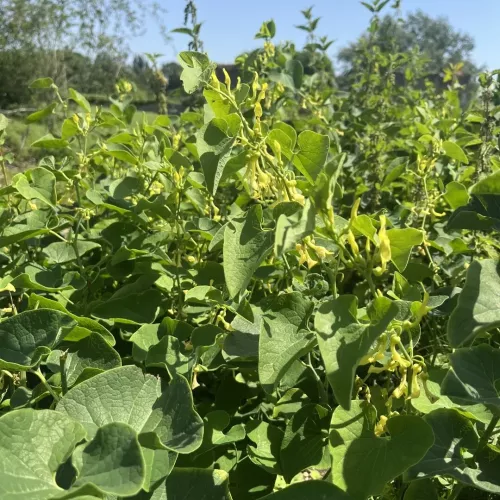
Birthwort flourishing in the drainage ditch at Godstow Abbey
More news
Contact us
- oge@admin.ox.ac.uk
- 01865 614460